The installed numbers, Asheville driveway by driveway
Asheville sits in a bowl ringed by the Blue Ridge, and its residential lots range from near-flat in the River Arts District to genuinely steep cuts on the hillside streets of North Asheville and Kenilworth. That topography shapes what any driveway costs more directly than brand, crew size, or current asphalt prices. A flat single-car approach in West Asheville is a fundamentally different project from a long serpentine run up a wooded lot in the East Asheville hills, and the prices reflect that gap.
Installed asphalt in Asheville runs roughly $4 to $8 per square foot, base and labor included. A residential driveway typically lands between $3,500 and $12,000, depending on size, slope, and what the lot demands below the surface.
| Scope of work | Typical Asheville range | What drives it |
|---|---|---|
| New install, flat lot, under 500 sq ft | $3,500 – $5,500 | Base depth, haul distance, truck access |
| Two-car, moderate grade, 600–900 sq ft | $5,000 – $8,500 | Grade correction, base depth, drainage |
| Replacement (tear-out included), flat to moderate | $5,500 – $9,500 | Removal, hauling, base rebuild |
| Steep hillside approach with drainage work | $8,000 – $12,000 | Grading, culvert, engineered base |
Those are working ranges, not quotes. Any number given before a contractor has walked your grade, checked truck access, and looked at where the water goes at the street is a guess dressed as an estimate.
What moves an Asheville price up or down
National asphalt averages are built from flat suburban data. In Buncombe County, a meaningful share of residential lots have enough grade to change the job fundamentally. Here is what creates the spread between a $3,500 driveway and a $12,000 one.
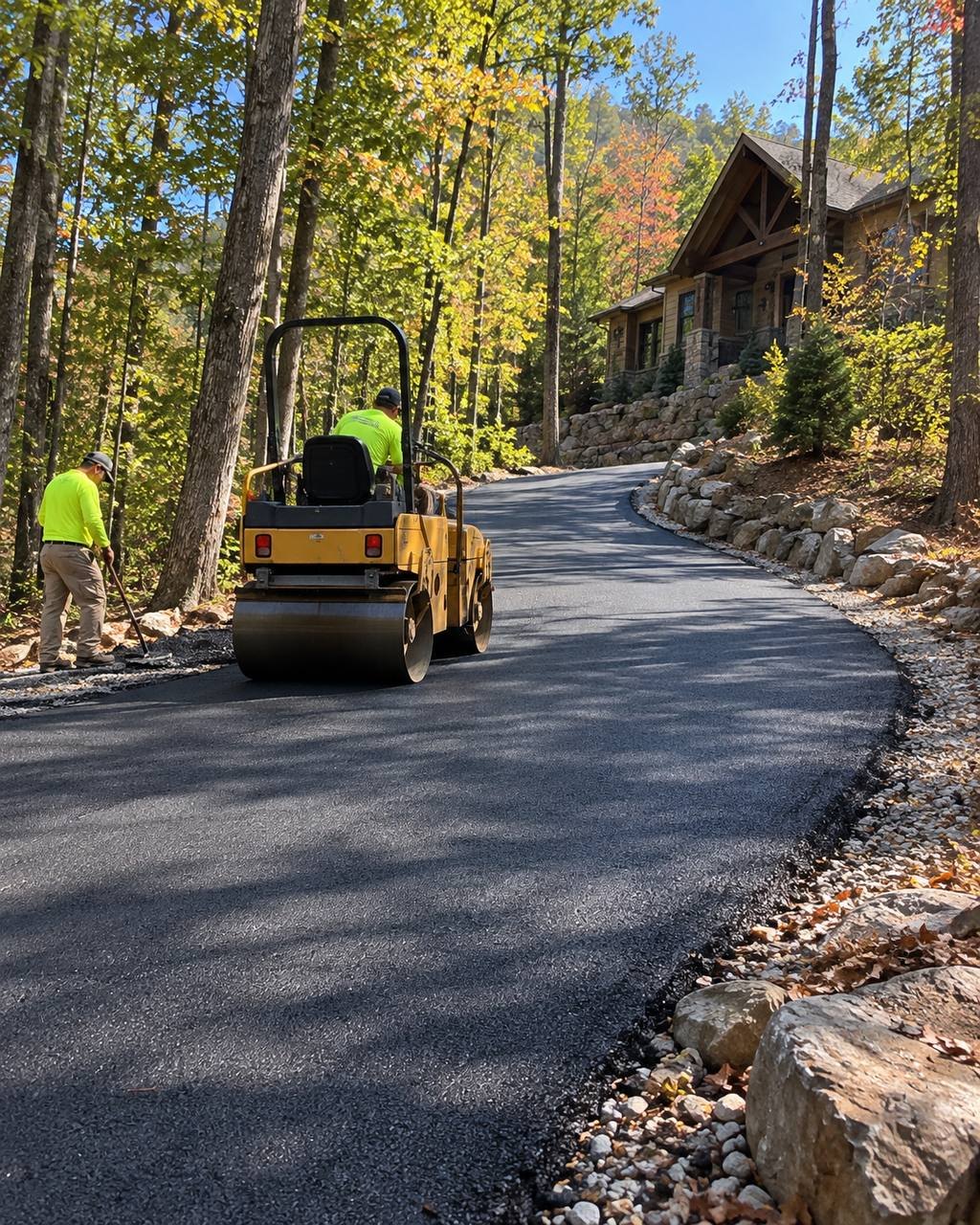
Grade and sub-base engineering. Even a moderate slope of 6–10% changes the base design. The sub-base must be compacted and crowned so water moves to the side rather than pooling or undercutting the asphalt edge. Steeper lots need more material and sometimes a retaining solution before paving starts. Asheville's hillside neighborhoods — parts of North Asheville, the streets above Kenilworth, the wooded approaches near the Biltmore Forest side of town — regularly fall into this category. See the full cost breakdown on our steep driveway paving page.
Rock and fill. Buncombe County sits on Piedmont and Blue Ridge metamorphic rock, and shallow outcrops are common on elevated lots. Rock excavation requires different equipment and more time; fill lots, common where older Asheville properties were terraced into hillsides, need compaction testing before asphalt holds reliably.
Base depth. Mountain climate brings real freeze-thaw cycles that the coastal plain barely sees. A properly built base in Buncombe County runs 6–8 inches of compacted stone; a 4-inch base may be sufficient for a Wilmington driveway but fails on cycle here. That extra base material is one reason per-square-foot costs in Asheville run toward the top of state averages.
Culverts and street drainage. Where a driveway approach crosses a drainage swale to reach the road, NCDOT or the City may require a culvert — typically adding $800 to $2,500 depending on length and depth. With 19 federal disaster declarations on record for Buncombe County (1973-2026), storm-water management is taken seriously by both inspectors and experienced local contractors.
Tear-out and base rebuild. Removing an existing concrete or failed asphalt surface and hauling debris typically adds $1.50 to $3.00 per square foot on top of the new surface cost. A 600-square-foot replacement adds $900 to $1,800 to the project before the first ton of hot mix arrives on site.
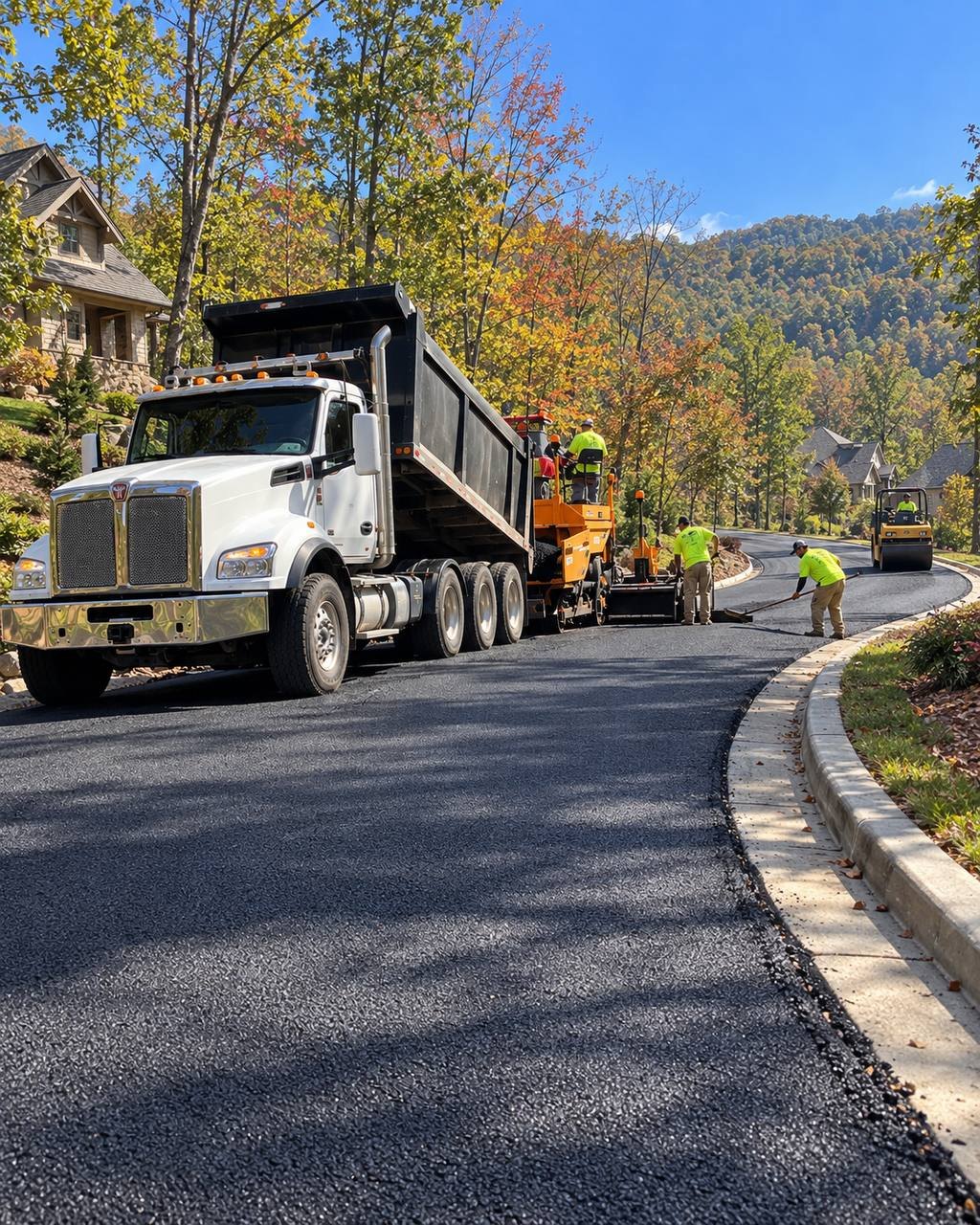
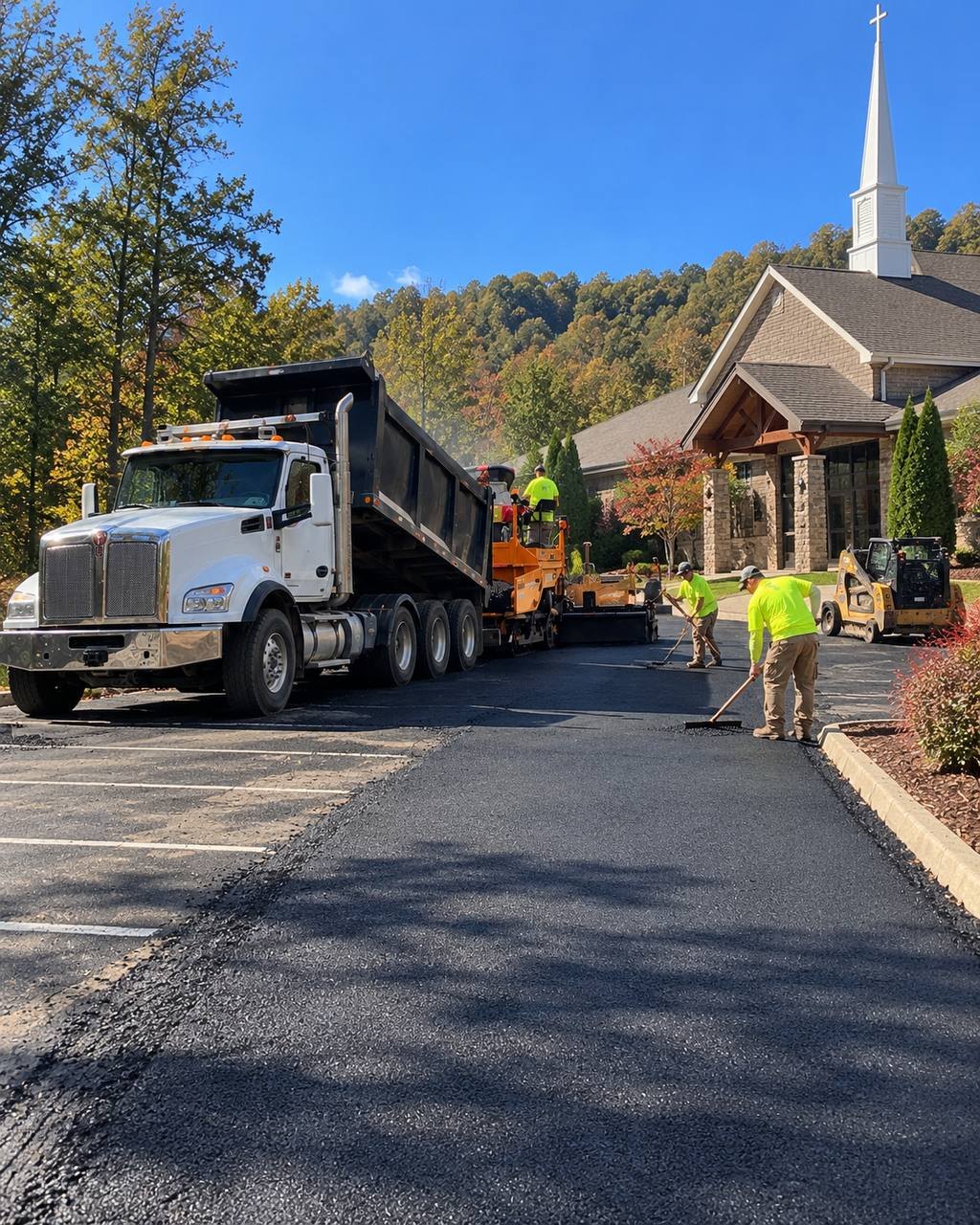
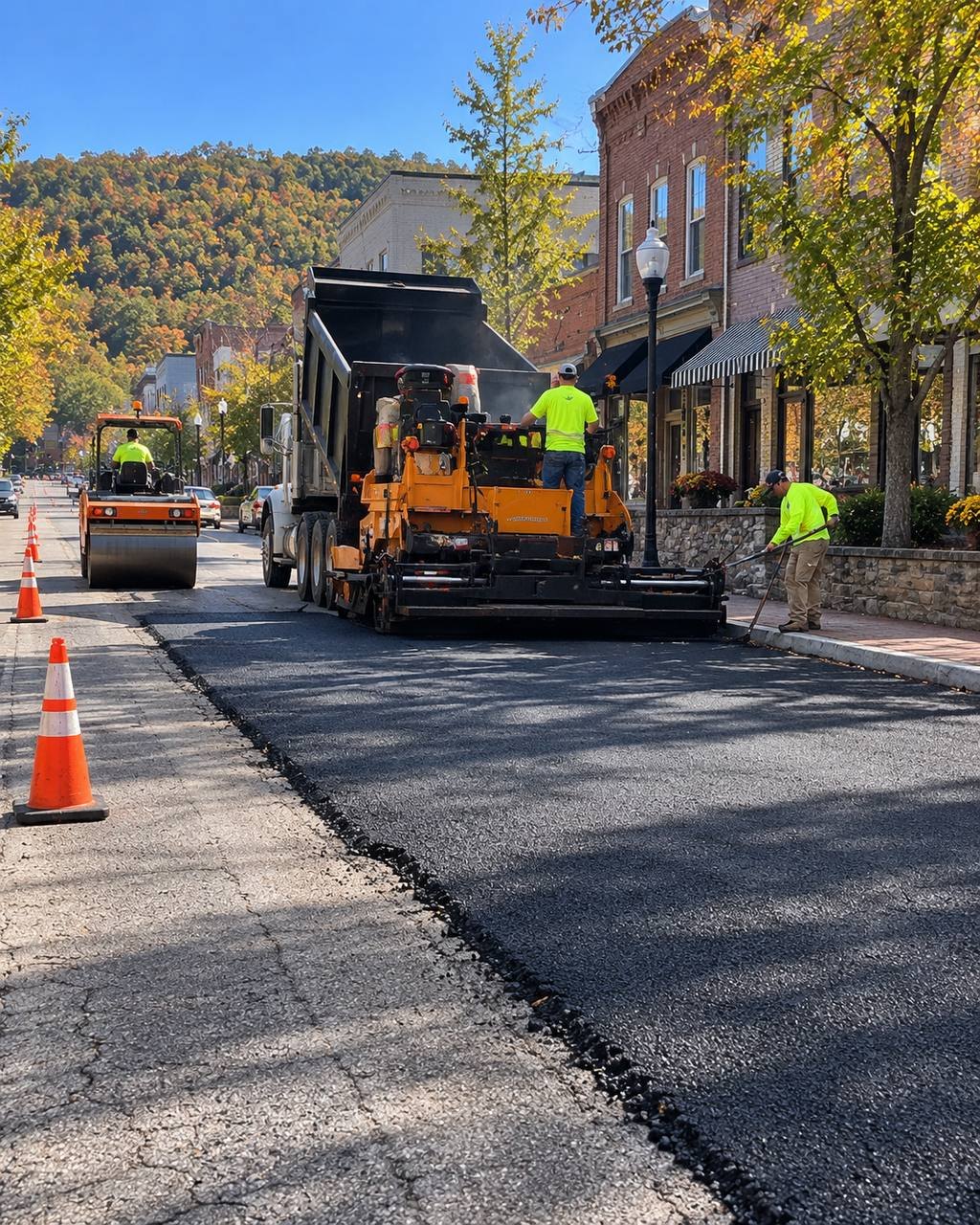
Truck access. Paving crews need a dump truck and a roller to follow the paver. Tight streets in Montford, the older blocks of West Asheville, and narrow residential lanes in North Asheville can restrict how equipment stages — sometimes forcing smaller gear or compressing the crew's working window in ways that affect surface quality.
Permits: city streets vs. state-maintained roads
Asheville has a split permit world that catches out-of-town contractors off guard. Whether you need a City of Asheville encroachment permit or an NCDOT driveway permit depends on whose road your driveway connects to — and that can change from one street to the next in the same neighborhood.
- City-maintained street. The City of Asheville controls curb cuts and driveway access onto streets it maintains. A right-of-way encroachment permit is required before work begins at the curb. The contractor typically pulls it; ask to see it before they start.
- NCDOT-maintained road. Driveways onto state roads — including many of the arterials that run through Asheville — require a driveway permit from NCDOT. Applications go through NCDOT Connect. NCDOT also sets specifications for approach width, culvert requirements, and sight-line distance that govern what the contractor can build at the street connection.
- Private road or HOA-controlled drive. These may not require a public right-of-way permit, though grading work of meaningful scope may still trigger a local building permit depending on the square footage disturbed.
A contractor who skips the permit question when connecting to a public road is leaving that liability with the property owner. It also tells you how they handle the rest of the job.
Asphalt, tar-and-chip, or gravel — what makes sense on Asheville lots
Asphalt is not the only answer for every Asheville driveway. Each surface trades off differently given local terrain, and the right call often depends on your specific slope and how the lot sits relative to the street.
Asphalt gives you a sealed, low-maintenance surface that handles Buncombe County winters well and is patchable when a frost heave or root opens a crack. It needs sealing every 3–5 years to slow edge degradation and prevent oxidation. On steep lots, edge erosion is the main failure mode when drainage is not built correctly — water undercutting the asphalt edge is a more common Asheville repair call than surface cracking from traffic load. Our full guide to asphalt paving in Asheville covers maintenance cycles, sealing timelines, and what to watch for on mountain lots.
Tar-and-chip typically costs somewhat less per square foot than hot-mix asphalt and provides better natural traction on grades — which is why it appears on many of Asheville's steeper residential approaches. It weathers naturally into the landscape, a quality that matters on wooded lots where a solid black surface can feel out of place. The trade-off is that it is harder to patch cleanly and may shed loose stone in the first season after installation. Our tar-and-chip guide for Asheville covers cost, longevity, and how it compares across specific slope ranges.
Gravel costs the least upfront but requires regrading every year or two on any meaningful slope as rain pushes material downhill. On a flat lot with good natural drainage it is a legitimate long-term choice; on a sloped Asheville lot the maintenance math flips past what asphalt would have cost within a few seasons.
How to get a written estimate that holds
Getting a meaningful asphalt quote in Asheville comes down to three steps that filter out ballpark numbers early.
Make the crew walk the lot. Any price given over the phone without seeing your grade, checking the street connection, and confirming truck access is a starting point, not a quote. Slope changes the base design; a drainage swale at the street changes the permit path; a narrow approach off a hillside lane changes what equipment can stage. There is no substitute for a crew member with their boots on your gravel.
Ask for a line-item breakdown. Base depth and material, asphalt tonnage, grading work, culvert installation if required, and tear-out should each appear as separate line items. A single lump-sum number makes change orders easy to add and hard to challenge once work is underway.
Compare the base specification. Ask each bidder what base depth and compaction standard they are proposing. The NCDOT pavement specifications give you a reference point for what a well-built road base looks like — residential driveways follow similar structural logic. A bidder proposing a 4-inch base for a steep Asheville lot is either inexperienced with mountain terrain or pricing to a thinner margin where it shows up years later, not on day one.
Once you have two or three written estimates, the spread will show you whether anyone is cutting the base, skipping the drainage, or treating the permit as optional. That comparison is worth more than any single number — and it is the fastest way to identify the contractor who actually knows Asheville lots.